
4.4 Explain How to Encourage Older People to Take Positive Risks
What Is a Positive Risk?
A positive risk is a choice or activity that carries some element of risk but has clear benefits for the person’s wellbeing, independence or happiness. The risk is planned, discussed and understood by the individual — not ignored or hidden.
Positive risk-taking is sometimes called risk enablement. It is not the same as reckless behaviour, because:
- The person is informed about what could go wrong
- The risk is assessed and reduced where possible
- The person chooses to go ahead
- Support is in place before, during and after
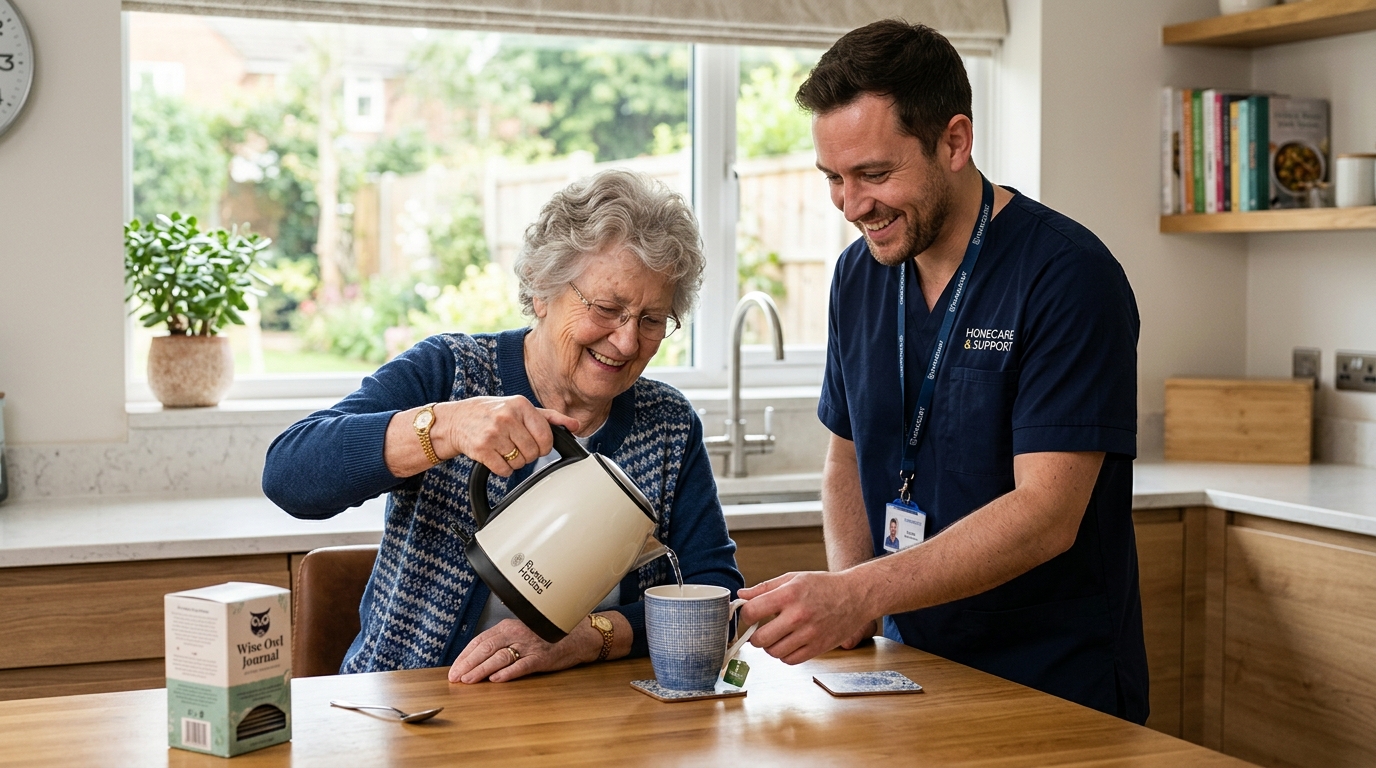
Example: An older person with mild arthritis wants to make their own cup of tea. There is a small risk of scalding. You assess the risk, move the kettle to a safer position, provide a lightweight kettle, and let them do it. The benefit — independence and dignity — outweighs the small, managed risk.
Why Positive Risk-Taking Matters in Older People’s Care
Older people are often over-protected. Well-meaning carers, family members and services can remove choice in the name of safety, which leads to:
- Loss of independence
- Loneliness and social isolation
- Depression and learned helplessness
- Physical decline (muscle loss, falls from inactivity)
- Loss of confidence and decision-making skills
Encouraging positive risks helps older people to:
- Maintain independence and daily living skills
- Stay physically active and mobile
- Keep social connections and reduce loneliness
- Protect mental health and self-esteem
- Retain decision-making capacity for as long as possible
- Live a life they value, not just a safe existence
This aligns with the wellbeing principle in Section 1 of the Care Act 2014, which requires care and support to promote the individual’s wellbeing — including their control over their own life.
UK Legislation and Frameworks You Should Reference
| Law / Framework | How it relates to positive risk |
| Care Act 2014 | Requires wellbeing, dignity and independence to be promoted; supports risk enablement |
| Mental Capacity Act 2005 | Presumes capacity; people have the right to make unwise decisions |
| Human Rights Act 1998 | Article 8 (private life) supports autonomy and choice |
| Equality Act 2010 | Prevents blanket restrictions applied because of age or disability |
| Safeguarding Adults (Care Act 2014 s.42) | Must be balanced against empowerment — safeguarding should not become over-protection |
| CQC Regulation 9 – Person-Centred Care | Requires care to meet individual needs and preferences |
| CQC Regulation 13 – Safeguarding | Requires protection from abuse and unnecessary restriction |
| NICE Guideline SC1 – Older People with Social Care Needs | Supports independence and choice |
Key point for your diploma: The Mental Capacity Act 2005 states that a person must be assumed to have capacity unless proven otherwise, and that a person is not to be treated as lacking capacity just because they make an unwise decision. This is the legal backbone of positive risk-taking.
How to Encourage Older People to Take Positive Risks — Step by Step
1. Start with a conversation, not a form
- Ask open questions: “What would you like to do that you’re not doing at the moment?”
- Listen for what the person values, not just what is medically advisable
- Avoid leading with risks — start with hopes and goals
2. Explore the activity together
- What exactly does the person want to try?
- What would success look like for them?
- What has stopped them before?
3. Discuss benefits and risks honestly
- Explain both sides in plain language
- Use phrases like: “The benefit could be… and the risk could be… What do you think?”
- Check understanding — ask them to repeat it back in their own words
4. Carry out a person-centred risk assessment
- Identify the specific hazards
- Rate the likelihood and severity
- Put control measures in place (equipment, support, timing, environment)
- Record it and review it
5. Provide the right support
- Offer to go with them the first time
- Arrange transport, equipment or a companion
- Agree a “check-in” plan
6. Respect the decision
- If the person has capacity and chooses to proceed, support them
- Document their decision and reasoning
- Escalate only if there is a serious safeguarding concern or legal duty
7. Review and celebrate
- Ask how it went
- Note what worked and what could be improved
- Use success to build confidence for the next step
A Person-Centred Example (Use This in Your Diploma)
Scenario: Mrs Patel, 82, lives alone. She has mild dementia but is assessed as having capacity for this decision. She wants to walk to the local shop alone, as she did for 40 years.
Risks: Getting lost, falling, traffic, fatigue.
Benefits: Independence, exercise, social contact, routine, identity.
How you encourage positive risk-taking:
- Discuss her wish and confirm she understands the risks
- Walk the route with her twice to check for hazards
- Suggest a shorter route and a mobile phone with your number saved
- Agree a time she will be back and a check-in call
- Inform her family with her consent
- Record the plan in her care plan and review after one week
Outcome: Mrs Patel goes to the shop twice a week. Her mood improves, she gets gentle exercise, and she keeps her independence. This is a proportionate, person-centred positive risk.
Balancing Safety and Opportunity
Too much caution is not “safe care” — it is restrictive practice. To balance both:
- Assess risk with the person, not for them
- Remove or reduce hazards where you can
- Use the least restrictive option
- Keep the person informed at every stage
- Review regularly — risk changes over time
Remember: The goal is not zero risk. The goal is acceptable risk with maximum quality of life.
The 5-Step Risk Assessment Process
- Identify the hazards
- Decide who might be harmed and how
- Evaluate the risk and decide on precautions
- Record your findings and share them
- Review and update
A risk assessment should never be used simply to say “no”. It should be used to ask: “How can we make this happen safely?”
Communication Tips
- Use plain English — no jargon
- Check hearing, vision and understanding first
- Give information in small chunks
- Use visual aids or written summaries if helpful
- Encourage questions
- Confirm consent — verbal or written
- Involve an advocate or interpreter if needed
Good communication is what turns a “no” into a “how”.
Involving Family, Friends and Advocates
Family can be a source of support — or a barrier. To involve them well:
- Get the person’s consent first
- Explain the plan and the benefits
- Invite them to help with practical arrangements
- Address their fears with facts and reassurance
- Share positive outcomes to build trust
If family disagree but the person has capacity, the person’s decision stands. Your role is to support and document, not to overrule.
Common Mistakes to Avoid
- Saying “it’s too risky” without exploring options
- Making the decision for the person
- Confusing safeguarding with over-protection
- Failing to record the risk assessment
- Ignoring the person’s wishes because family disagree
- Assuming someone lacks capacity because of their age or diagnosis
- Never reviewing the plan
Key Takeaways for Your Diploma
- Positive risk-taking = informed choice + managed risk + person-centred support
- Always start with the person’s wishes, not the risk
- Use the Care Act 2014 and Mental Capacity Act 2005 to justify your approach
- Risk assessments should enable activity, not block it
- Document everything: the discussion, the decision, the review
It means supporting a person to make an informed choice to do something that carries some risk, because the benefits to their wellbeing outweigh the dangers. It is planned, documented and person-centred.
Because over-protection causes isolation, loss of independence, depression and physical decline. Positive risk-taking helps older people maintain dignity, purpose and quality of life.
It presumes capacity, supports the right to make unwise decisions, and requires any restriction to be in the person’s best interests and the least restrictive option available.
If you have followed policy, completed a risk assessment, documented the person’s informed decision and acted within your role, you have met your duty of care. Always escalate serious concerns to your manager.
A positive risk is an informed, planned choice by a person with capacity. A safeguarding concern involves actual or risk of abuse, neglect or harm where the person cannot protect themselves. The two must be balanced carefully. Give one example of encouraging an older person to take a positive risk. Supporting an older person to cook a simple meal independently by providing adapted equipment, moving hazards and supervising from a distance — improving independence while managing risk.